Call WhatsApp Enquire
Strainers & Filters · Coarse Filtration

Y, T & Conical Strainers

Coarse filtration within a compact body, protecting downstream equipment from scale, weld spatter, sand and construction debris. Y and T strainers are designated by the configuration of the housing, and both are applied wherever solids loading is light. A Y strainer retains less material than a basket strainer of equivalent size — the consequence of its smaller envelope, lower cost and installation flexibility — and on horizontal lines carrying a comparatively clean fluid it is ordinarily the appropriate selection.
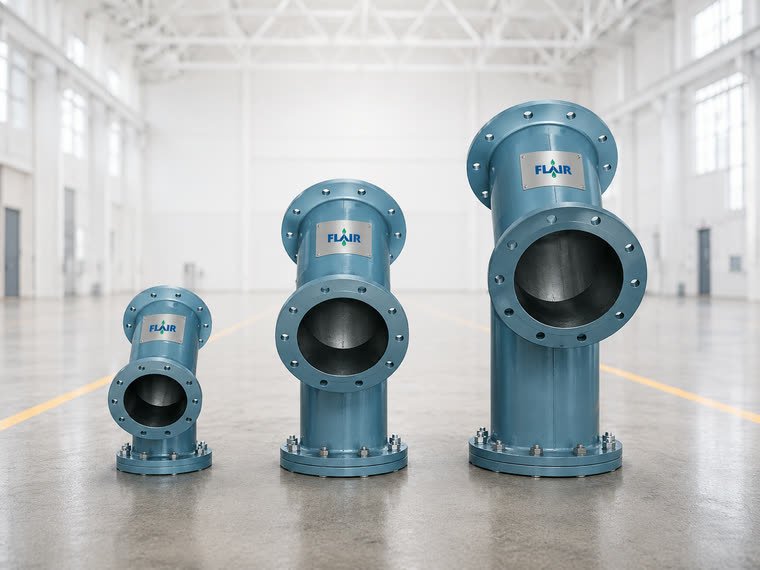
Flair Y strainer installed on a process line Photograph of completed unit
Y, T & Conical Strainers
Construction & Types

Three body styles, one function

Manufactured in cast and fabricated construction, in Y, T and conical body styles, and selected against line orientation, dirt holding requirement and the available face to face dimension.

Y strainer Compact, general duty

Screen set at an angle to the flow within a Y configured body. Suitable for horizontal or vertical installation. Available in cast construction in the smaller sizes and fabricated in the larger.

T strainer Higher dirt holding

Inline body with the element in a straight run, offering greater dirt holding capacity than a Y strainer of equivalent size and improved access for cleaning. Applied on larger bore lines.

Conical strainer Restricted envelope

Cone configured element installed between flanges, applied where the available face to face dimension is restricted or where straining is required only during commissioning.

Cast and fabricated body Size dependent

Cast bodies are economical in the smaller sizes and standard pressure classes; fabricated bodies, rolled and welded from plate, are used in larger sizes, at higher pressures, or for non-standard dimensions.

Specification

Standard range

Where a stated range does not cover a particular requirement, equipment is engineered to the customer specification.

Size range 15 mm to 600 mm
Construction Cast or fabricated, Y, T or conical body
Design code ASME Sec VIII Div 1 on fabricated units, IBR on request
Filtration range Coarse
Element type Perforated sheet, mesh lined perforated sheet, wedge wire
End connections Screwed, socket weld, butt weld or flanged
Orientation Horizontal or vertical, blowdown oriented downward
Options Blowdown connection with plug or valve, magnetic insert, jacketing, DP tappings
Materials of Construction

Grades routinely handled

Carbon Steel SS 304 SS 304L SS 316 SS 316L

Cast bodies are ordinarily supplied in carbon steel or stainless steel; fabricated bodies are rolled and welded from plate in the same grades. Alloy steel, duplex stainless and other grades are quoted against the process fluid. The screen or perforated element is selected independently of the body, so a carbon steel body fitted with a stainless steel screen is a routine specification, particularly on steam and condensate service.

FAQ

Common questions

A Y strainer suits horizontal or vertical lines carrying a comparatively clean fluid where the envelope is limited. A T strainer offers greater dirt holding capacity and easier access for cleaning, and is generally used on larger bore lines. A conical strainer is fitted between flanges where the face to face gap is restricted, or where straining is only needed during commissioning. Send us your line size and expected solids loading and we will recommend the appropriate type.
A Y strainer is suitable for both horizontal and vertical installation, but the pocket should be oriented so the screen stays fully submerged and the blowdown connection, where fitted, points downward. On steam and vapour lines the pocket is ordinarily oriented horizontally or downward to prevent condensate collecting above the screen.
A blowdown connection with a plug or valve allows accumulated solids to be flushed from the pocket without removing the screen, which is useful on lines that see continuous light debris. It is an option rather than a standard fitting, so specify it if your duty would benefit from periodic flushing between full cleanings.
Y, T and conical strainers are coarse filtration devices, intended to catch scale, weld spatter, sand and construction debris rather than fine particulate. The perforation or mesh count is set against what the downstream equipment can tolerate — a control valve or steam trap manufacturer’s data sheet is the usual reference point. Send us the equipment being protected and we will confirm the rating.
A conical strainer is fitted directly between two flanges rather than requiring its own housing, so it suits situations with a restricted face to face dimension or a temporary requirement such as pre-commissioning flushing. Once that duty is complete it is often removed and the line closed with a spacer, whereas Y and T strainers remain in permanent service.
Cast bodies are economical in the smaller sizes and standard pressure classes. Fabricated bodies, rolled and welded from plate, are used in larger sizes, at higher pressures, or where a non-standard dimension or material is required. We manufacture both, and the choice is generally driven by size and pressure class rather than preference.
Pressure drop depends on the open area of the screen relative to the pipe bore and on the solids loading at the time. A clean screen with adequate open area adds very little; the reading rises as solids accumulate and is the practical signal for cleaning. Confirm your flow rate and fluid and we will size the screen to keep clean pressure drop within an acceptable range.
Yes, this is one of their principal applications — typically installed upstream of steam traps, control valves and pressure reducing stations to protect them from scale and weld debris carried in newly commissioned or older steam and condensate lines. Confirm the design pressure and temperature so the body and screen material are selected accordingly.
Enquiry

Request a quotation for Y, T & Conical Strainers

Give us the line size, flow rate, fluid and operating conditions and we will engineer directly against them. Most enquiries are answered the same working day.