Call WhatsApp Enquire
Filtration · Continuous Duty

Self-Cleaning Filters

Where solids loading renders manual cleaning impractical, a self-cleaning filter performs the duty in situ. A scraper or brush assembly traverses the internal surface of the element, displaced solids settle into a collection chamber, and filtration continues uninterrupted.

Manual and motorised versions are manufactured with wedge wire or disc edge elements, in standard models across a range of flow rates or engineered wholly to the customer requirement. Filtration is achieved to 50 micron.
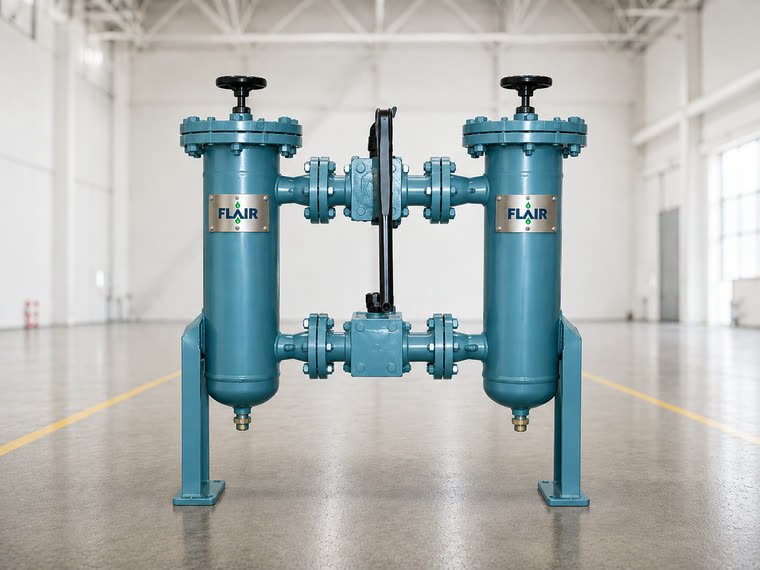
Flair self-cleaning filter installed on a process line Photograph of completed unit
Self-Cleaning Filters
Operation

Manual or motorised cleaning

A scraper or brush assembly traverses the internal surface of the element, displacing accumulated solids into a collection chamber below, while filtration continues without interruption.

Manual Attended duty

A handwheel mounted on the housing drives the scraper assembly. Economical and reliable, appropriate where the unit is attended in the ordinary course of operation.

Motorised Unattended duty

A geared motor drives the scraper, initiated on a timer or on differential pressure across the element. Collected solids are purged through a drain valve, manually or automatically.

Specification

Standard range

Where a stated range does not cover a particular requirement, equipment is engineered to the customer specification.

Size range 50 mm to 600 mm
Filtration range 50 micron and above
Element type Wedge wire or disc edge
Cleaning Manual handwheel or motorised scraper
Control Timer, differential pressure switch, or both, with local panel
Design code ASME Sec VIII Div 1 where required
End connections Flanged as standard
Options Automatic purge valve, DP transmitter, PLC control panel, jacketing, skid mounting
Materials of Construction

Grades routinely handled

Carbon Steel SS 304 SS 316

The element is ordinarily stainless steel regardless of housing material, since it is the wearing and cleaning surface subject to continuous scraper contact. The housing itself is offered in carbon steel for general water and utility duties, or in stainless steel where the process fluid or hygiene requirement calls for it. Other grades are quoted on request against the specific duty.

FAQ

Common questions

A manual unit is cleaned by turning a handwheel that drives the scraper assembly across the element, appropriate where the housing is attended in the ordinary course of operation. A motorised unit uses a geared motor to drive the scraper automatically, initiated on a timer or on differential pressure, and is selected where the line runs unattended or where cleaning frequency is too high for manual operation to be practical.
On a timer, on a differential pressure switch across the element, or on both together with a local control panel. A timer suits a fairly constant solids loading; a differential pressure trigger responds directly to the actual condition of the element and is the more efficient method where loading varies.
A wedge wire element is built from a continuous wedge-profile wire wound around support rods, giving a robust, non-clogging slot suited to a wide range of duties. A disc edge element is built from stacked profiled discs, and is generally selected for finer ratings or where a particular flow pattern through the element is required. We will recommend the type against your fluid and target micron rating.
Solids scraped from the element settle into a collection chamber at the base of the housing and are purged through a drain valve, either manually at intervals or automatically as part of the motorised cleaning cycle.
Where the solids loading is high enough that manual cleaning would demand frequent shutdowns, or where the line must run continuously without operator intervention. A self-cleaning filter performs the cleaning duty in situ so filtration continues without interruption.
Standard units are built to ASME Sec VIII Div 1, and IBR construction is offered on request where the application requires it. Advise us at enquiry stage so the unit is engineered and documented accordingly from the outset.
Yes, this is a routine specification. The element is ordinarily stainless steel regardless of the housing material, since it is the wearing and cleaning surface, while the housing is selected against the process fluid and pressure rating.
An automatic purge valve, a differential pressure transmitter, a PLC control panel, jacketing for temperature-sensitive fluids, and skid mounting can all be fitted. Specify the process conditions and duty and we will confirm which options are relevant.
Enquiry

Request a quotation for Self-Cleaning Filters

Give us the line size, flow rate, fluid and operating conditions and we will engineer directly against them. Most enquiries are answered the same working day.