Three way and multiport valves were developed initially for use within our own duplex filter assemblies and are now supplied as a product line in their own right. They are designed, manufactured and tested in accordance with BS 5251 Section One, BS 6755 Part 1, API 598 and API 6D. L port configuration is applied for diverting between two outlets, T port for mixing or for simultaneous supply to two lines. Both are available lever operated, gear operated or actuated.
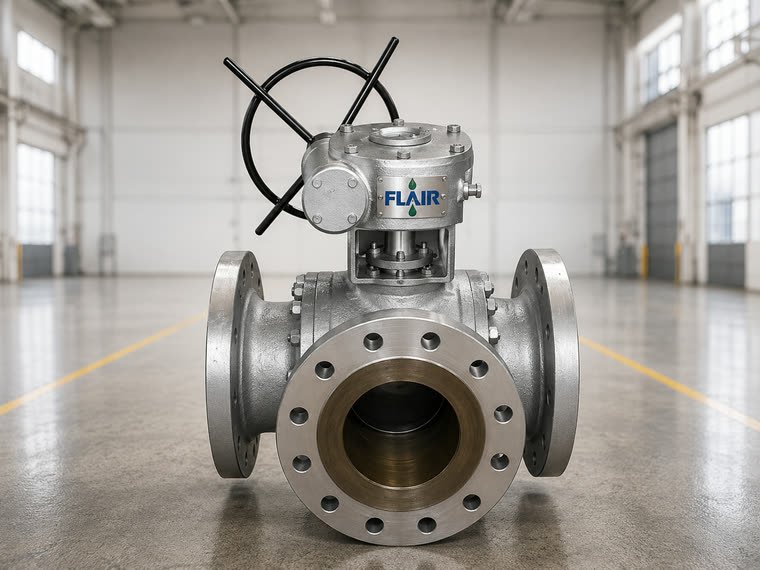 Photograph of completed unit
A three way ball valve routes, diverts or mixes flow between two or three connections through a single ball with an L or T shaped bore. Selected against the port pattern the routing requires and the operating method the installation calls for.
Connects one inlet to one outlet at a time, with the third port shut off. Applied for diverting flow between two outlets or two chambers, such as changeover on a duplex filter.
Permits mixing two inlets into one outlet, or supplying two outlets simultaneously from one inlet. Applied where flow must be combined or split rather than simply diverted.
Lever operation suits smaller sizes and infrequent use; gear operation reduces the torque needed to turn larger valves by hand.
Pneumatic or electric actuation for remote operation, frequent cycling, or integration into an automated control sequence.
Where a stated range does not cover a particular requirement, equipment is engineered to the customer specification.
| Size range | 15 mm to 300 mm |
|---|---|
| Port pattern | L port and T port, four way on request |
| Design and test standards | BS 5251 Section One, BS 6755 Part 1, API 598, API 6D |
| Pressure rating | Class 150, 300 and 600 |
| Body construction | Two piece or three piece |
| End connections | Flanged, screwed, socket weld or butt weld |
| Seat material | PTFE, RPTFE, PEEK or metal seat on request |
| Body materials | Carbon steel, SS 304, SS 316, alloy on request |
| Operation | Lever, gear operator, pneumatic actuator or electric actuator |
| Options | Locking device, limit switch, ISO 5211 mounting pad, extended stem |
Carbon steel suits standard utility and process duty; stainless is specified for corrosive fluids or where product purity matters. Seat material is selected against the process fluid and temperature, with PEEK or a metal seat available on request for higher temperature or abrasive service.
Give us the line size, flow rate, fluid and operating conditions and we will engineer directly against them. Most enquiries are answered the same working day.